Contact Details
Contact Admissions
Visit us
For visitors to the senior school
Portsmouth road
Esher, Surrey
KT10 9HZ*
(*Please note this is nearest postcode)
A very warm welcome
Here is some helpful information which, in our experience, sixth form students and their families have most needed to know. The formal provision we offer is set out in our terms and conditions and our various school policies which can be found on the website.
If you need further information or have any concerns whatsoever, do not hesitate to contact us using:
- our general email address: seniorschool@claremont.surrey.sch.uk
- or the main telephone number: 01372 467 841.
We hope this information is helpful, and we’ll keep you updated throughout the year about any policy or procedural changes via our weekly communications and the parent portal.
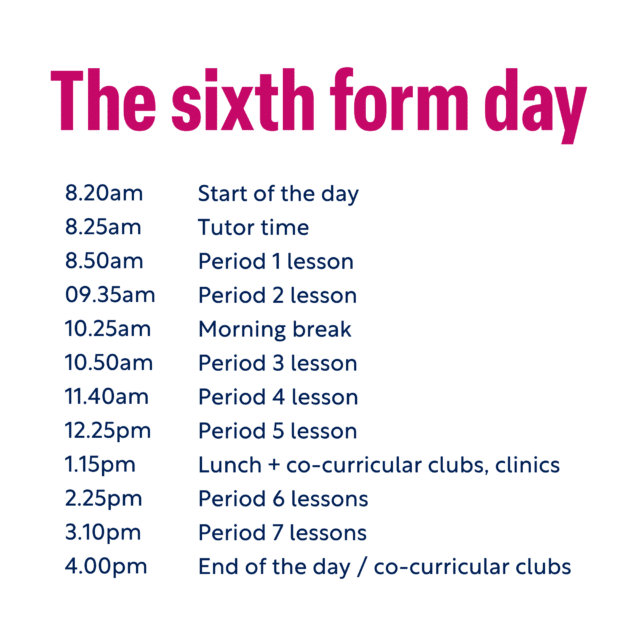
The sixth form day
Sixth form privilege pass system
Privilege passes reward students for “getting it right”.
The privilege pass system offers you increasing permissions to leave the campus at designated times around lessons and other commitments during the day.
As a Year 12 student you will begin your first half term with the opportunity to earn a ‘privilege pass’ by demonstrating high standards of behaviour, attendance, punctuality, engagement and independent study. The better the standard, the greater the privilege.
Following each academic review, you will be awarded a gold, silver or bronze privilege pass, which will give you differing levels of flexibility to come and go from campus.
Year 12 students begin the first half term without a privilege pass. This provides an opportunity to establish positive routines, demonstrate consistently high standards and develop the independent study habits expected in the sixth form.
The privilege pass system is designed to:
- Recognise and reward students who consistently demonstrate high standards.
- Equip students with the independent study skills and habits they need to thrive in sixth form and beyond.
- Embed a culture of high expectations around learning, attendance, punctuality and personal presentation.
The three levels of privilege pass (Gold, Silver, Bronze), depend on:
- Performance in subjects, attitude to learning, attendance, punctuality, meeting deadlines, general behaviour and dress-code.
- Academic reviews and Head of Sixth Form discretion.
Gold Privilege Pass:
Students must be in the sixth form centre from 8.20am each day to be ready for tutor time at 8.25am. Students can leave the campus at lunchtime. Students may leave early on any day after 12.30pm, if they do not have further lessons or an after-school commitment. Students must sign in and out of the school site when exercising this privilege.
Silver Privilege Pass:
Students must be in the sixth form centre from 8.20am each day to be ready for tutor time at 8.25am. Students can leave the campus at lunch. Students must sign in and out of the school site when exercising this privilege. Students should then remain on site until 4pm each day.
Bronze Privilege Pass:
Students must be in the sixth form centre from 8.20am each day to be ready for tutor time at 8.25am. Students can leave the campus at lunch once per week. Students must sign in and out of the school site when exercising this privilege.
No Privilege Pass:
Where the standards outlined above are not consistently met, a privilege pass will not be issued. Students without a pass are expected to remain on campus during break and lunch and to be in sixth form for all periods (1–7), Monday to Friday.
UCAS application process 2026-27
Throughout the two years of sixth form, students will meet a member of the student futures team individually to support them through the UCAS procedure and guide them through the research and application process for next steps, whether university or apprenticeships.
Students will use Unifrog to record competences, work experience and research university and apprenticeship options.
During the second half of the summer term and the first half of the autumn term, students will work on their personal statements and choose their courses. Their draft application form will be completed in Unifrog.
Students are further supported through the UCAS process by their tutors, subject specialists and the head of sixth form. Once the student has a personal statement ready and has chosen degree courses to apply for, they will then have an interview to review their application with a member of the Senior Leadership Team.
When the student, senior management and student futures are satisfied that the UCAS application form is complete, the fee is paid and the application is submitted, by the school.
By 1 December 2026, all students will have either completed an online UCAS application form to meet the 13 January UCAS deadline. Alternatively, they should have confirmed other options including apprenticeships and studying abroad.
Applications for Oxbridge, Medicine, Dentistry and Vet Medicine/Science should be ready by 22 September to meet the 15 October UCAS deadline.
Admissions tests will then be completed during the summer term.
When the student has heard from all the universities they applied to, they must meet their subject mentor and a member of the student futures team to discuss the choices available.
By 1 May 2027 students should have confirmed the following to the student futures team and the head of sixth form:
- a) that they have confirmed their firm and insurance decisions online;
- b) their grades or pointsrequired;
- c) their plans for deferred entry.
The head of sixth form and the student futures team will be at school when the results of the A levels are given to students. They will be able to advise about any other further contact that might need to be made with university admission officers.
UCAS form instructions
- Use yourpersonalemail address, choose a password you can remember. Link our UCAS HUB account to school using the buzzword claremont2027
- Write down the username.
- For the feecode, select 01 for self-funded or 02 for student loan in the box unless you are an overseas student whose parents have not lived here for three years.
- Area of permanent residence will usually be Surrey or one of the Greater London boroughs. Middlesex does not exist.
- Take great care when completing details of your qualifications. Start with the three A levels you will be taking in the summer and show the grade as “Pending” and the date as June 2027.
- You will need to know the exam boards for all your subjects at GCSE and A level.
- When you have completed every section, the words Pay/Send will appear in the toolbar. Do not forget to click on this. The screen will then ask you for payment details.
- Your application will then be sent to the UCAS advisors side of the site. If you want to alter your Personal Statement, or any other section, the student futures staff will need to send it back to you and when you have altered it just click on Pay/Send again. It will not ask you for any more money. You will complete your final application with the student futures team and send it off together.
- After you have had your interview with a member of the Senior Leadership team, we will add the reference and your predicted grades to your application and then send them together with your application to UCAS. You will receive an email from UCAS to tell you it has arrived.
SIXTH FORM DRESS CODE & APPEARAN
Sixth form dress code & appearance
Dress for the role you’re stepping into.
The sixth form dress code reflects Claremont’s values, high expectations and the greater responsibility that comes with being a senior student. Looking smart and professional helps create a purposeful learning environment and marks an important transition: greater independence, more mature study and relationships with teachers and increased responsibility for your own success.
Additionally, those in Year 12 and 13 naturally act as role models for younger pupils and represent the school more widely. We therefore expect you to approach how you dress with maturity and pride in your position in sixth form, a focused, purposeful stage of education. This supports you making the most of your time at Claremont’s sixth form as you prepare for what comes next.
Our smart dress code is not about being restrictive. Rather, it helps set clear boundaries between the sixth form day and personal time, encouraging a professional mindset. It also gives students valuable experience in dressing appropriately for university interviews, job interviews and apprenticeship assessments.
General appearance requirements.
Hair should be neat, clean, natural in colour and not obscure the face. Facial hair is not accepted. In certain instances, such as PE, science and DT hair may need to be tied up for safety reasons and staff will insist on this. Hair should not be extreme and/or unnatural, and judgement on this is at the discretion of the deputy head, pastoral. For those with pierced ears, one or at most two studs in each ear is acceptable. Small hoops can be worn in the sixth form. No other jewellery should be worn, and no other body piercings should be visible. Makeup or nail varnish is not permitted for pupils in Years 7-11. Tattoos must not be visible when wearing school uniform or sports kit. Exceptions to all these rules for religious or other personal reasons, should be discussed with heads of house/year and agreed with them and the deputy head (pastoral) in advance of any change.
It is at the discretion of the head of sixth form to make any amendments to the above.
Higher education key dates
You have been given a Higher Education support document that you should use to find out more about your UCAS application and to check the timeline of support and deadlines.
Summarised below are some of the key dates – keep these in mind when completing your booklet as the dates may inform some of your targets.
| Term | Year 12 | Year 13 |
| Autumn term |
|
|
| Spring term |
|
|
| Summer term |
|
|
| Summer holidays |
|
|
Co-curricular
COMING SOON
Autumn term’s co-curricular clubs programme.
School systems links
THE PARENT PORTAL
- The parent portal is the main hub for all up-to- date information and guides for parents.
- Click here to login.
- Download the app from the app store: Firefly for Parents.
ALL SYSTEMS CAN BE ACCESSED EASILY VIA THE PARENT PORTAL.
MyEVOLVE app (and website)
- myEVOLVE manages trip bookings, payments and consent forms for educational trips and residentials.
- Parents can also purchase small sundry items in EVOLVEshop.
- Parents will receive a booking and payment invitation link via email for all school trips.
- Trips can be booked and paid for via the email link or parents can access their myEVOLVE account to book, pay, consent and view the trips.
- Parents should do a fi rst-time sign up for myEVOLVE using the quick link on the parent portal.
- Support: seniorschool@claremont.surrey.sch.uk
VECTARE APP (AND WEB PORTAL)
- The Vectare passenger app is for families who use the school bus service.
- Book your child’s bus journey, and follow bus tracker live updates.
- Download the app via the parent portal, or click here.
- Support: claremontfancourt@vectare.co.uk or call the live ops line: 0115 777 3198
ipayimpact online tuck payments (app and website)
- Pupils pay for tuck using a cashless system linked to their ID cards.
- Set up an account using activation code provided by the school.
- One time sign-in via the parent portal, or log in here. (an iPayimpact app is also available)
- Transfer funds into your child’s tuck account
- Support: billing@claremont.surrey.sch.uk
Teen tips well being hub (website)
- The wellbeing hub is a parenting resource for all Claremont families.
- This platform off ers ‘hints and tips’, courses, webinars and other content to help you support your child.
- Register a user account using the link on the parent portal.
- Support: hub@teentips.co.uk
SOCS Sports (website)
- Provides up to date fixture information, contact details, team sheets and results.
- URL: claremontfancourtsport.co.uk
- Support: juniorsport@claremont.surrey.sch.uk
unifrog (website)
- Supports students in planning their future beyond Claremont.
- Particularly helpful for pupils from Year 9 through to sixth form students.
- Link available via the parent portal, or click here.
- Use code: CFCSparents
Revision Tips
There are many different strategies you can use to revise but some of the preferred methods are not always the most effective. Here are some tips, backed up by cognitive science, to help you prepare for your exams.
HOW TO REVISE
Break your revision down into 1-hour chunks and stick to your revision timetable. Here is how you should spend your hour:
- Spend 5 minutes getting everything out that you need: notes,textbook, laptop, pens etc. Most importantly, make sure your phone is not on view (ideally in another room).
- Spend 25 minutes taking notes from your class notes/textbook/videos/work on Teams. Here is how to spend your time well:
- Don’t just read and highlight information as this does not help you commit the information to memory.
- Decide what works for you e.g. using flash cards, mind maps or a notebook. This will depend on subject content as well as your preference for note taking.
- Now take a 5-minute break. It is important to have a complete change of environment so go for a short walk around the house/garden.
- Spend 25 minutes completing exam practice questions.
- The questions don’t need to be related to the topic you have just taken notes on but they need to be questions that require you to apply your knowledge.
- It doesn’t matter if you are not fully prepared to answer the questions, just have a go and use the mark schemes at the end to check your answers. It’s important you check your answers by using the mark schemes so that you don’t learn any misconceptions.
- Spend the last few minutes recording what you know and what you need to improve on next time you revise this topic again.
THE BEST WAYS TO IMPROVE YOUR MEMORY
Retrieval practice
How to do it:
- This is where you generate answers to questions e.g. past papers, practise essay questions and multiple-choice questions use learning platforms such as Seneca/Kahoot/Blooketetc.
Why it works:
- Retrieval practice helps combat the negative effects of stress (exams) and so you are better prepared for exam conditions.
- In studies, students who practised this method performed up to 50% better in their exams than those who just re-read their notes.
Spacing
How to do it:
- Do little chunks of revision, often. Cramming is not effective so it is important to follow your revision timetable.
- The further away the exam, the longer the gaps between study sessions should be. When you are on the verge of forgetting the information, is the best time to revisit and revise this material.
- Interleaving is also useful. This is when you alternate topics and subjects you are revising. Again, follow your revision timetable!
Why it works:
- Using spacing instead of cramming has resulted in a 10-30% difference in final exam results, according to several studies.
- We tend to remember the first and last things we revise so revisiting the material is important to fill gaps in our knowledge.
- In another study, students who spaced out their revision sessions scored 74% higher than those who crammed.
Reading out loud
How to do it:
- Study by reading the information out loud is 12% more effective than reading in silence. You could also create a recording of yourself and listen back to it.
Why it works:
- Reading out loud is an active event and it requires visual processing so it helps establish anchors in the brain to make knowledge stick. It is also self-referential meaning that because you read the information, it is more meaningful and therefore easier to remember.
Drawing for learning
How to do it:
- Drawing pictures which relate to the information you are studying means you create something new from the material you are learning. Students who did this performed better in their final exams.
Why it works:
- You need more learning time to draw the pictures so you have more time to analyse and process the information covered. Students who drew pictures also reported putting more effort into their learning.
Teaching others
How to do it:
- Students who had to teach the material to someone else remembered more of the material and did so in a more efficient way than those who did not. As a result, they performed 12% better in test conditions.
- Teach your family about the information you have learnt. Explain it to them whenever you can e.g. at the dinner table or on a car journey.
Why it works:
- Verbalising the information you have learnt requires a need to understand it in order to explain it to others.
- The only thing to be wary of is that you are not teaching misconceptions! Make sure the information you are teaching is accurate.
THE BEST WAYS TO IMPROVE YOUR WELLBEING
Sleep
How to do it:
- Aim for at least 9 hours a night. Try and have a consistent bedtime routine by going to bed and getting up at the same time each night.
Why it works:
- A good night’s sleep prior to learning allows you to create new memory associations. When sleep deprived, you are more likely to forget positive memories and focus on negative ones. This can increase anxiety and low mood.
Exercise
How to do it:
- When taking revision breaks, go for a walk as it increases the feelings of happiness, attentiveness and confidence. Even a 5-minute walk is more beneficial than sitting down during rest breaks. You don’t even need to walk outside to feel the benefits.
- Those who regularly exercise cope better with stressful situations and report feeling more alert and focused.
Why it works:
- Exercise helps to oxygenate the brain and release tension, helping you to keep calm, mentally relax and study more efficiently.
Diet
How to do it:
- Eat healthily and have regular meals whilst revising and in particular make sure you have breakfast every day.
Why it works:
- Students who ate breakfast showed better memory and attention.
- It has also been linked to better eating habits and improved physical and mental health.
Screen time
How to do it:
- Small amounts of screen time are not harmful and may even have some benefits. Being on a screen for one hour before bed hardly affects your sleep but more than this is damaging.
- Turn down the back light on your phone a few hours before bed to help you sleep.
Why it works:
- Using a screen for two hours before bed results in 20% less melatonin (the sleep hormone) being released which will affect your sleep. This is particularly detrimental during stressful times such as exam periods when you are already finding it hard to sleep.
THE WORST WAYS TO REVISE
Highlighting your notes– despite this being the favoured method of students it does not commit information to long-term memory
Simply re-reading notes– this does not make information stick and you are easily distracted when reading notes
Cramming– this will only allow information to enter your short-term memory which has extremely limited capacity
Having your phone in the room with you– the mere presence of a phone leads to a 20% reduction in attention, concentration and performance
Revising to music– students who revised in quiet environments performed over 60% better in exams than those who listened to music
Further Information
Ms Aline Norris is your point of contact for admissions into our sixth form and she is available to answer your initial enquiries at admissions@claremont.surrey.sch.uk or on 01372 473 780.
Claremont’s sixth form
Welcome to Claremont’s sixth form, a vibrant community where you will be supported to achieve more than you imagined. This is a defining stage of your education – a time to follow passions, seize opportunities and develop the skills and confidence which will undoubtedly shape your future.