News
·15 July 2026

For visitors to the senior school
Portsmouth road
Esher, Surrey
KT10 9HZ*
(*Please note this is nearest postcode)
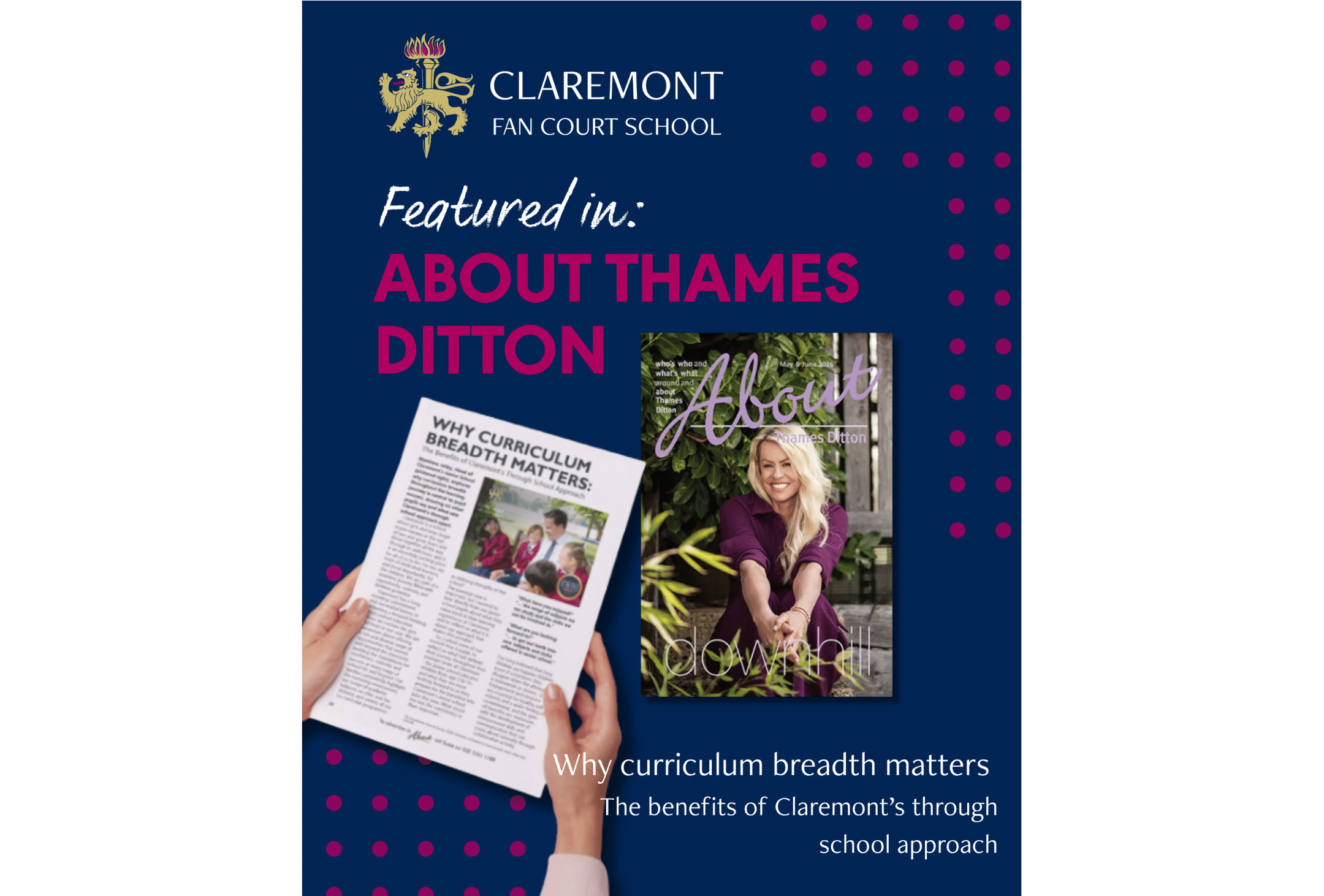
The benefits of Claremont’s through school approach
Matthew Jelley, head of Claremont’s junior school, explores why curriculum breadth throughout the learning journey is central to pupil success, drawing on what pupils say and what sets Claremont’s through school approach apart.
We are proud to be featured in About Thames Ditton. Click the link below to read the article and see us on page 38.
Claremont is a school where girls and boys begin in pre-nursery at the age of two and grow, learn and thrive together all the way through to sixth form, and it is an incredibly exciting place for all of us to be. For me, my team of dedicated teachers, and most importantly for the children, we are part of a seamless journey filled with opportunity, curiosity and limitless potential.
Claremont has a longstanding commitment and successful history of delivering a forward-thinking, child-centred education where we nurture the girls and boys in our care. We are passionate about offering a rich and diverse range of opportunities that extend well beyond the classroom, building the foundations for confidence, curiosity and success at every stage of school life and beyond.
Our families consistently highlight the nurturing environment, our range of academic subjects on offer, and the richness and variety of our co-curricular programme as defining strengths of the school.
The parental view is important, but I wanted to hear directly from our junior school pupils about what they value most in their learning experiences at Claremont, and to reflect on what it is about our approach that makes this possible.
So, I asked some of our current Year 6 pupils to reflect on what had defined their journey throughout their younger years at Claremont. The junior school educates children from age 2 to 11, and I asked what they are most looking forward to as they prepare for the transition into Claremont’s senior school later this year. What struck me was the consistency in their responses.
“…the range of subjects we can study and the clubs we can be involved in.”
“…to get our teeth into new subjects and clubs offered in senior school.”
I’ve long believed that busy children are happier children, even if sometimes they disagree when the alternative is homework or chores. Engagement and purpose are essential for healthy self-esteem and a wider feeling of contentment, and the spin-off benefits are numerous, with the development of interpersonal skills and communication that can come about naturally through collaborative activity.
That’s why schools, particularly at primary level, need to develop a culture of busyness, in lessons, at recreational time, and even in the school holidays. Evidently, from our Year 6 feedback, the children wholly endorse this approach too.
At Claremont, we believe in a curriculum that encompasses all activity we organise from the time children enter the school site to the time they leave, not just “lessons”. This is underpinned by the aim to be “broader for longer”.
Parent feedback places both our junior and senior schools above other independent day schools for the range of academic subjects offered, underlining the strength and continuity of our through-school curriculum.
What does this look like in practice for younger children?
Children benefit from subject specialist lessons in art, design, music, drama, dance, French, Spanish, computing, PE and sport, Forest School and science throughout junior school, with many of those subjects delivered to our youngest children from the age of two.
The junior co-curricular programme is equally broad. Designed for children of every age, ability and interest, pupils can find something to excite and enthuse them and provide meaningful engagement, from go-karting club and lacrosse to music composition, podcasting, gardening, running, swimming, crafting, debating, stretch and challenge activities, and much more.
One parent commented:
I feel that my child receives a well-rounded education and is constantly exposed to new ideas and new experiences. There’s a good recognition of the balance that children need to be happy and thrive.
Claremont junior school parent
So why does the “broader for longer” mantra matter, and where is the evidence behind the strategy?
In 2025, Claremont achieved its strongest A Level results to date, alongside impressive value added at GCSE, with pupils performing almost a full grade above nationally standardised predictions per subject. We believe this is closely linked to sustaining a broad and rich curriculum for as long as possible, developing in pupils a sense of purpose, happiness and a mindset where busier often means happier and more successful.
While the education system often narrows as children move through the stages, at Claremont we are committed to preserving variety for as long as possible, inspiring pupils to explore widely and discover their “thing”.
In an AI world where transferable skills matter, Claremont challenges the view that early test preparation is the best route through the transition from primary to secondary school. Instead, we prioritise a rich, balanced curriculum that favours depth and discovery over simply preparing children to jump through the hoops of testing at 11+.
We believe this approach provides the strongest foundation for future academic success, and the evidence supports it.
As a through school, there is additional benefit. Through carefully managed transitions to the senior school, and with a thorough understanding of each child, staff support the journey from early years into Key Stage One, Key Stage Two and beyond, genuinely getting to know every child and fostering within them a love for learning.
We can seek out and deliver those “wow” moments, knowing what makes each child tick, to inspire and fill our children with a sense of awe and wonder, and to develop a sophisticated and secure understanding of self, others and the world in which we live.
*RS Academics Parent Survey 2026. Features compared to benchmarks from other day schools.
News
·15 July 2026

News
·6 July 2026

News
·9 June 2026